Commercial Painting — Winnipeg, MB
Epoxy Floor Coatings for Winnipeg's Toughest Floors
100% solid epoxy, polyaspartic, and urethane floor systems for garages, warehouses, labs, and commercial kitchens. Chemical-resistant, slip-rated, and built for Manitoba winters.
Epoxy Floor Coatings
Epoxy Floor Coatings Built for Manitoba's Hardest Floors
Concrete floors in Winnipeg's commercial and industrial buildings take a beating that most people don't think about. Forklift tyres transfer abrasion energy directly to the surface every time they turn. Chemical spills from manufacturing processes or vehicle fluids attack the concrete matrix. Food processing facilities have to meet CFIA sanitation standards that require a seamless, non-porous floor surface. And every winter, chloride-laden water tracked in from Winnipeg's roads attacks the concrete slab.
A quality epoxy floor coating system addresses all of these problems simultaneously. It creates a hard, dense surface film over the concrete that resists abrasion, chemical penetration, moisture ingress, and microbial growth. It makes the floor cleanable with industrial cleaning equipment. It can be slip-rated to the required coefficient of friction for the application. And it lasts significantly longer than uncoated concrete in high-traffic environments.
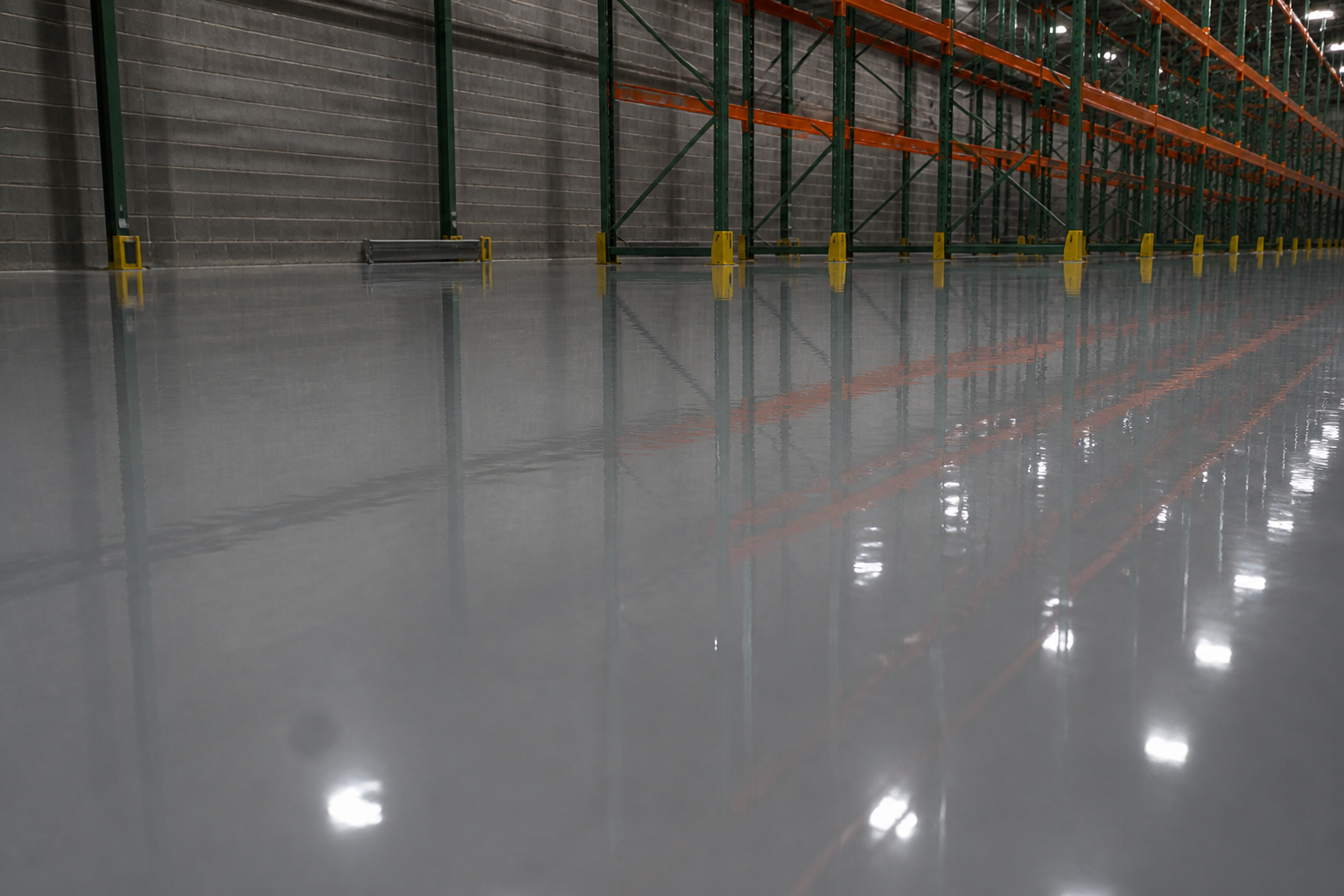
We install 100% solids epoxy, water-based epoxy, polyaspartic, and polyurethane floor coating systems in warehouses, distribution centres, manufacturing plants, commercial kitchens, pharmaceutical facilities, auto shops, and commercial garages throughout Winnipeg and surrounding Manitoba communities. Each project starts with a substrate assessment — concrete hardness, moisture content, and existing coating adhesion — before a product is ever specified.
Understanding Epoxy Floor Systems: Product Selection for Winnipeg Facilities
Not all epoxy floor coatings are the same. The word 'epoxy' describes a chemistry, not a performance level. A 50% solids water-based epoxy produces a film thickness of roughly 3–4 mils dry — fine for light commercial use. A 100% solids epoxy produces 8–12 mils dry per coat — appropriate for medium industrial use. A multi-coat high-build system with a self-levelling broadcast aggregate can reach 40–60 mils — the right choice for heavy industrial, food processing, or forklift-traffic environments.
For most Winnipeg warehouse and light industrial applications, we specify a three-coat system: a penetrating epoxy primer that chemically bonds to the concrete, a 100% solids epoxy build coat, and a polyurethane topcoat for UV resistance and superior abrasion performance. The polyurethane topcoat is particularly important in Winnipeg facilities with skylights or near loading dock doors — it doesn't yellow under UV exposure the way a straight epoxy does.
For food processing, pharmaceutical, and laboratory environments, we use a 100% solids epoxy system with a coved base detail — the floor coating runs up the wall 6–8 inches in a curved, seamless transition that eliminates the corner crack where bacteria and contamination accumulate in a standard square base. CFIA-approved facilities require this detail, and we install it to spec.
For automotive garages and parking structures, we use a polyaspartic topcoat over a moisture-tolerant epoxy primer. Polyaspartic coatings cure faster than standard epoxy — often to vehicle traffic in 4–6 hours — and they're more resistant to hot-tyre delamination, the failure mode where heat from a vehicle's braking cycle softens a standard epoxy and creates the bubbled surface you see in garage floors after a few years.
Epoxy Floor Coating Services
- Concrete surface preparation — shot blasting, diamond grinding, acid etching as required by substrate condition
- Moisture vapour testing (ASTM F2170) before product specification
- Crack and joint repair with appropriate polyurea or epoxy injection products
- 100% solids epoxy broadcast systems for heavy industrial use
- Water-based epoxy for light commercial, retail, and showroom floors
- Polyaspartic topcoat for automotive, parking, and fast-cure applications
- Anti-slip aggregate broadcast for areas requiring R11 or R12 slip ratings
- Coved base installation for food processing, healthcare, and pharmaceutical facilities
- Floor marking and safety striping — pedestrian lanes, forklift zones, hazard demarcation
- Food-safe CFIA-compliant floor systems for food processing environments
Epoxy Floor Installation in Winnipeg: The Process in Detail
The single most important step in a quality epoxy floor installation is surface preparation. At least 80% of epoxy floor failures are caused by inadequate surface preparation, not by product quality. We use shot blasting as our primary preparation method — a machine that propels steel shot at the concrete surface at high velocity, creating the CSP (Concrete Surface Profile) that epoxy coatings require for mechanical adhesion. Shot blasting is faster and more consistent than grinding and leaves a cleaner surface than acid etching.
Before any product is applied, we test the concrete's moisture vapour emission rate (MVER) using the calcium chloride test (ASTM F1869) or the relative humidity probe method (ASTM F2170). In Winnipeg, where seasonal groundwater tables fluctuate significantly, moisture vapour from below-grade concrete is the leading cause of epoxy floor delamination. If MVER exceeds 3 lbs/1000 sq ft/24 hours, we specify a moisture-tolerant epoxy primer before the standard system — this adds cost but eliminates the risk of a bubble-and-peel failure 18 months post-installation.
After surface preparation and moisture assessment, we apply the primer coat and allow it to cure to the specified recoat window. This step is where impatient contractors lose the project — rushing the prime-to-build coat interval means you're applying product to a partially cured primer that can't form the required chemical bond. We follow manufacturer's technical data sheets precisely, adjusting for ambient temperature and humidity conditions on the day of application.
Maintaining Epoxy Floors in Winnipeg's Climate
An epoxy floor coating is a long-term investment — a quality system in a warehouse environment lasts 10–15 years before a full recoat is needed. But that lifespan assumes reasonable maintenance. The biggest threat to epoxy floors in Winnipeg is salt and calcium chloride brought in on vehicle tyres and foot traffic during winter. Chloride ions penetrate any surface damage — chips, scratches, expansion joint edges — and attack the concrete below, causing corrosion that delamination from the substrate.
The maintenance program we recommend for Winnipeg epoxy floors includes daily dry sweeping or auto-scrubbing to remove grit before it acts as an abrasive under tyre or foot traffic, weekly wet cleaning with a neutral pH cleaner (never acidic), and annual inspection and spot repair of any surface damage. Chips and impact damage repaired promptly with an epoxy fill product prevent moisture ingress that accelerates deterioration.
Expansion joints in the concrete slab should always be maintained through the epoxy system — the joint allows the slab to move, and bridging it with epoxy will eventually crack. We install a flexible polyurea joint filler at every expansion joint in our floor systems. When the joint filler shows wear or shrinkage, it's replaced as a maintenance item rather than a failure indicator.
Epoxy Floor FAQ — Winnipeg
How long before a new epoxy floor can handle forklift traffic?
For a 100% solids epoxy system with a polyurethane topcoat, full cure to heavy vehicle traffic is 72 hours at 20°C. Pedestrian traffic is typically allowed at 24 hours. Polyaspartic systems are faster — vehicle traffic in 4–6 hours in most temperature conditions.
Can you coat an existing epoxy floor?
Yes, if the existing floor is in good adhesion condition and properly profiled. We test adhesion using a cross-cut or pull-off test, then mechanically abrade the surface before applying the new coat. Failed, bubbled, or delaminating existing epoxy must be removed before recoating — painting over a failed floor produces another failed floor.
Can epoxy be installed in winter in Winnipeg?
Indoor installations can proceed year-round as long as the workspace can be maintained above 10°C for water-based systems or 15°C for 100% solids systems, and the concrete substrate temperature is above the dew point. We bring portable heaters for heated work areas in winter. We won't install epoxy on a slab showing moisture or frost.
How do I clean an epoxy floor in a commercial kitchen?
Use a neutral pH cleaner — pH 7–9 — with an auto-scrubber or mop. Acidic cleaners (citric-based degreasers) and strongly alkaline cleaners attack the epoxy binder over time. Hot water and steam cleaning up to 80°C is fine for food processing environments. Avoid dragging metal equipment across the surface — rubber or plastic pads on all equipment feet.
Get a Quote
Request a Quote for Epoxy Floors
Ready to get a proper commercial painting quote for your epoxy floors project in Winnipeg? The Winnipeg Commercial Painting Co. handles the full project from first walkthrough to documented handover. Fill this in and we'll respond within one business day.