Commercial Painting — Winnipeg, MB
Industrial Painting Built to Last in Winnipeg's Climate
High-build epoxy, rust-inhibiting primers, and durable top coats for warehouses, distribution centres, and manufacturing plants. Built for Manitoba's freeze-thaw punishment.
Warehouse & Industrial Painting
Industrial Painting Built for Manitoba's Harshest Environments
Warehouses and industrial facilities in Winnipeg face a specific set of painting challenges that have nothing to do with aesthetics. You're dealing with massive interior volumes that require specialized spray equipment to coat efficiently. You're dealing with concrete block, metal deck ceilings, exposed steel structure, and tilt-up concrete walls that each require a different primer and topcoat system. And you're dealing with the relentless Winnipeg climate — freeze-thaw cycles that destroy a poorly chosen exterior coating in a single winter.
We've painted distribution centres, cold-storage facilities, manufacturing plants, automotive service shops, and agricultural processing buildings throughout Winnipeg and rural Manitoba. We understand industrial painting from a project management standpoint: the trades are still on site, the racking is loaded, the fork trucks are moving, and we're painting around the operation. That's the normal context for this type of work, and our crews are trained for it.
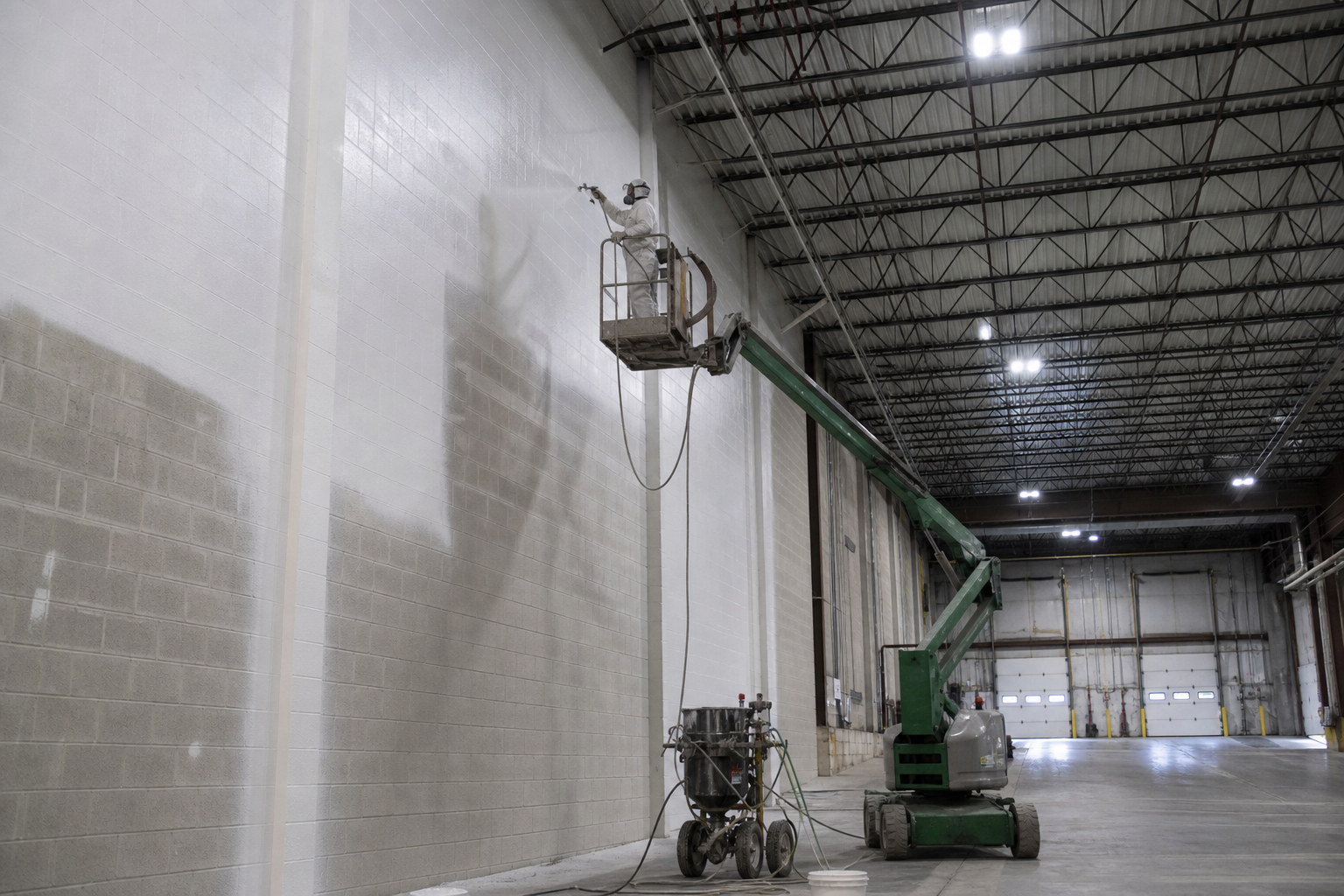
Our industrial painting scope typically includes interior concrete block walls, structural steel members and beams, metal deck ceilings, overhead doors and dock seals, floor markings and safety striping, and exterior facades. We bring airless spray equipment, boom lifts, and elevated work platforms as needed — we don't rent equipment at project start and figure out the scope. All of that is sorted in the estimate walkthrough.
Coating Systems for Warehouse and Industrial Environments
A warehouse wall is not painted with the same product as a restaurant or an office. The right system starts with understanding the substrate and its condition. Concrete block — the most common warehouse interior wall material in Winnipeg — is typically painted with a block filler primer followed by an industrial-grade acrylic or epoxy topcoat. The block filler bridges the open texture of the block, reduces topcoat consumption, and provides a smooth substrate for the finish coat.
For chemical resistance — in facilities handling solvents, acids, food processing chemicals, or fuel — we specify a two-part epoxy or polyurethane system. These coatings cure through a chemical cross-linking reaction rather than simple solvent evaporation, which gives them a molecular structure that resists penetration by aggressive chemicals. They're also far more abrasion-resistant than latex systems, which matters in high-traffic areas where equipment and product handling is constant.
Metal deck ceilings in warehouses are typically painted with a rust-inhibiting primer followed by a white or light-coloured acrylic topcoat. Light-coloured ceiling finishes significantly improve ambient light levels in warehouses, which directly reduces energy costs for high-bay LED fixtures. We've seen lighting efficiency studies showing that a freshly painted white ceiling can reduce fixture output requirements by 15–20% while maintaining the same foot-candle levels at the floor.
Structural steel — columns, beams, joists — is painted with a zinc-rich or rust-inhibiting primer followed by a polyurethane or alkyd topcoat for industrial environments. In areas where fire-rated intumescent coatings are required by the Manitoba Building Code, we work with the specified intumescent product and confirm application thickness per the fire-rating schedule.
Industrial Painting Services We Provide
- Concrete block wall painting with block filler prime coat and industrial acrylic or epoxy topcoat
- Structural steel priming and topcoating with rust-inhibiting systems
- Metal deck ceiling painting — white or light colour to improve light reflection
- Epoxy floor coatings — 100% solid, polyaspartic, and water-based systems
- Floor safety markings — pedestrian lanes, forklift paths, hazard zones
- Overhead door and dock door painting — interior and exterior
- Exterior tilt-up, masonry, and metal cladding painting
- Cold storage and freezer room coatings rated for low-temperature adhesion
- Intumescent fire-rated steel coatings where code-required
- Air quality management — HEPA filtration and dust control during spray application
Painting Occupied Warehouses Without Stopping Production
Asking a warehouse operator to shut down for painting is often not realistic. Product is moving, staff are working, trucks are loading and unloading. We don't need the building empty to paint it. What we need is a clear communication plan and a phased work zone approach.
Our industrial crews are trained to set up mobile containment zones that isolate active painting areas from operational areas. We use zippered poly barriers to contain spray overspray, set up industrial air movers to maintain directional airflow away from product and personnel, and coordinate painting windows with the facility manager to work in zones when traffic is lowest. Typically, that means painting ceiling sections and high wall areas during shift changes or low-traffic periods, and floor marking work happens after the last shift of the day.
For overnight production: we can mobilize on large warehouse projects with crews that work the full 10pm–6am window, painting ceiling grids and upper wall courses while the daytime crew prepares surfaces and moves equipment. This parallel scheduling dramatically reduces total project duration on large facilities.
Warehouse Painting FAQ — Winnipeg
What's the minimum temperature for painting a warehouse in Winnipeg?
For water-based products, the minimum application temperature is 10°C and rising. For solvent-based epoxy and polyurethane systems, 15°C minimum with substrate temperature verified by probe. Manitoba winters make late-fall exterior work marginal — we assess per project and won't apply product in conditions that will compromise adhesion.
How do you paint high-bay areas above 20 feet?
We use articulating boom lifts for high-bay work, supplemented with airless spray equipment for ceiling and upper wall areas. All boom lift operators hold the required provincial certifications and equipment is inspected before each shift. Work at height is our standard, not our exception.
Can you paint a warehouse floor while the building is in operation?
Yes, in sections. We close one section at a time — typically weekend overnight windows — apply the epoxy system, and allow the required cure time before reopening to foot and equipment traffic. Full cure to forklift traffic for a 100% solids epoxy is 72 hours; pedestrian traffic can return in 24 hours in most cases.
What's the lifespan of a warehouse wall coating in Manitoba?
A properly applied industrial acrylic system on concrete block in an interior warehouse environment lasts 8–12 years before a full recoat is needed. Epoxy systems last 10–15 years. Regular touchup of impact damage extends both. Exterior coatings on masonry or concrete in Winnipeg's climate typically require refresh every 5–7 years.
Get a Quote
Request a Quote for Warehouse Painting
Ready to get a proper commercial painting quote for your warehouse painting project in Winnipeg? The Winnipeg Commercial Painting Co. handles the full project from first walkthrough to documented handover. Fill this in and we'll respond within one business day.