Commercial Painting — Winnipeg, MB
Exterior Painting Built for Winnipeg Winters
Masonry, stucco, metal cladding, wood siding, and EIFS — we prep to bare substrate and apply coatings engineered for -40°C freeze-thaw cycles. No peeling after one winter.
Exterior Commercial Painting
Exterior Commercial Painting Built for Winnipeg Winters
Exterior painting in Winnipeg is a different science than exterior painting in Vancouver or Toronto. The temperature differential between our coldest winter day and our hottest summer day exceeds 75°C. That thermal cycling exerts enormous mechanical stress on any coating system — expansion on warm days, contraction on cold ones, repeated over hundreds of cycles per year. Add in freeze-thaw cycling of any moisture that gets under or into the coating, and you understand why cheap exterior paint jobs in Winnipeg peel after one winter.
We specify exterior coating systems for Winnipeg's climate specifically. That means elastomeric products with high elongation on masonry and stucco, direct-to-metal alkyd or polyurethane systems on steel cladding, moisture-tolerant acrylic systems on EIFS and foam substrates, and properly primed alkyd systems on wood. Every substrate gets the system it actually needs — not the cheapest available product with the widest marketing claim.
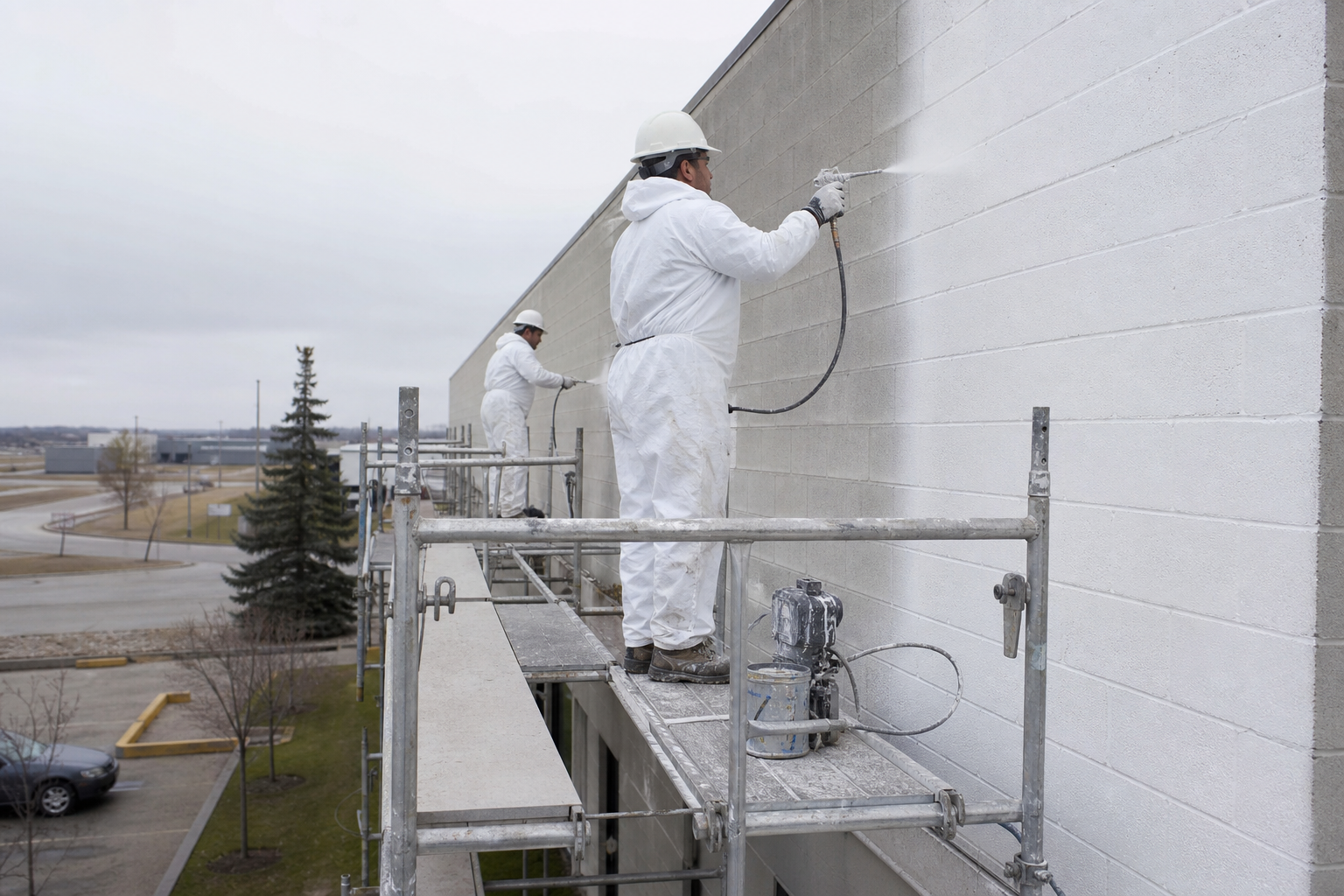
Our exterior commercial painting work in Winnipeg covers office building facades, retail storefronts, warehouse and industrial exteriors, hotel and hospitality exteriors, institutional buildings, and multi-unit residential buildings. We apply by brush and roller for smaller detail work and airless spray for large facade areas, always with appropriate masking to protect windows, doors, landscaping, and adjacent surfaces.
Exterior Coating Systems for Every Commercial Facade Type
Concrete block and poured concrete are the most common exterior wall materials in Winnipeg's commercial inventory. The correct coating system starts with a masonry filler or block filler primer that penetrates the open pore structure of the block and provides a uniform substrate for the topcoat. On poured concrete, we use a penetrating primer that seals the concrete surface and provides a chemical bond site for the topcoat.
For masonry topcoats, we use 100% acrylic elastomeric systems for most Winnipeg exterior applications. The elastomeric designation means the coating has an elongation of at least 200% — it stretches rather than cracks as the substrate moves. This is critical on Winnipeg masonry where hairline cracks and joint mortar movement are a constant reality. A standard acrylic paint on cracked masonry will show every crack as a paint failure within one season. An elastomeric system bridges those cracks and maintains a continuous weatherproof film.
Steel cladding and metal panel systems are coated with a system appropriate to the metal type. Galvanized steel requires a zinc-compatible primer — standard oil-based or rust-inhibiting primers don't bond well to galvanized surfaces and will delaminate. Bare steel gets a zinc-phosphate or zinc-rich primer for corrosion resistance. Aluminum gets an etching primer before topcoat. Each topcoat is a polyurethane or polyvinylidene fluoride (PVDF) system for maximum UV resistance in Manitoba's high-UV summer conditions.
EIFS (External Insulation and Finish Systems — commonly called 'dryvit') require special consideration. The foam substrate is incompatible with solvent-based coatings, which will dissolve it. Only approved water-based acrylic systems can be applied over EIFS without damaging the substrate. We always verify substrate type before specifying a product — the wrong product on EIFS is not recoverable without replacing the system.
Exterior Commercial Painting Scope
- Masonry, brick, and concrete block painting with elastomeric or breathable acrylic systems
- Stucco and EIFS painting with substrate-compatible water-based coatings
- Metal and steel cladding painting with direct-to-metal or zinc-primed systems
- Wood siding and trim painting with appropriate primer and alkyd or acrylic topcoat
- Window frame, door, and storefront painting in applicable system
- Soffit and fascia painting — aluminum and wood substrates
- Parapet and coping painting where accessible
- Caulking and joint sealant replacement before paint application
- Power washing and surface cleaning before all exterior painting
- Scheduling within Manitoba's exterior painting season — May through September
Surface Preparation for Exterior Commercial Buildings
The condition of an exterior commercial building before the first brush hits it is the most important factor in how long the new coating lasts. We spend more time on surface preparation than most painting contractors — typically 40–50% of total project hours on larger exterior jobs. That time goes into power washing, caulking replacement, mechanical removal of failed paint, masonry crack repair, rust treatment on metal, and priming bare substrate.
Power washing is always the first step on exterior work. We use a hot-water pressure washer at appropriate pressure for the substrate — typically 1500–2500 PSI on masonry, 500–1000 PSI on wood, and just enough to remove loose material and algae from EIFS without damaging the foam substrate. Algae and mould on exterior surfaces must be killed before painting — painting over living organisms doesn't work; the organisms continue to grow under the film and cause adhesion failure.
Caulking at all window perimeters, control joints, penetrations, and base flashing conditions is replaced before painting rather than painted over. Painting over cracked or failed caulk locks in the failure and makes it harder to address in the future. New backer rod and sealant at every joint is the correct approach — it's a small addition to the project cost with a large impact on the system's weatherproofing performance.
Exterior Commercial Painting FAQ
What time of year can you paint exterior commercial buildings in Winnipeg?
Our exterior painting season is typically mid-May through late September. We require ambient and substrate temperatures of at least 10°C for water-based products and 15°C for solvent-based systems, with temperatures staying above these levels for 24 hours post-application. October work is possible in some years but we won't guarantee performance on late-season work.
How do you paint multi-storey commercial buildings?
We use scaffolding, swing stage suspended platforms, aerial work platforms (boom lifts), and pressure washing equipment as required for height access. All equipment is inspected and operators are certified. For glass-and-steel facades where swing staging is not practical, we use bosun's chair or rope access for targeted touch-up and repair work.
How long does an exterior commercial paint job last in Winnipeg?
A properly specified and applied elastomeric system on masonry lasts 8–12 years in Winnipeg's climate. Polyurethane topcoats on metal cladding last 7–10 years. Standard acrylic systems on wood last 5–8 years with regular caulking maintenance. These are real-world Winnipeg figures — not manufacturer's lab ratings.
Do you handle masonry crack repair as part of exterior painting?
Yes. Hairline cracks in mortar joints are filled with an elastomeric sealant before painting. Larger structural cracks in masonry or concrete are repaired with a hydraulic cement compound or a two-component epoxy injection system depending on the crack width and depth. We document all crack locations and treatment methods — useful for building condition records.
Get a Quote
Request a Quote for Exterior Painting
Ready to get a proper commercial painting quote for your exterior painting project in Winnipeg? The Winnipeg Commercial Painting Co. handles the full project from first walkthrough to documented handover. Fill this in and we'll respond within one business day.